How Does a Child Become Addicted to Drugs? Understanding the Root Causes
 by
by How Does a Child Become Addicted to Drugs? Understanding the Root Causes
When we see a child using drugs, our first reaction is often:
“This child is bad.”
“He has fallen into bad company.”
“He has destroyed his life.”
But I think we are asking the wrong question.
Instead of asking, “Why is this child taking drugs?” we should ask:
“What happened in this child’s life that made drugs feel like an escape?”
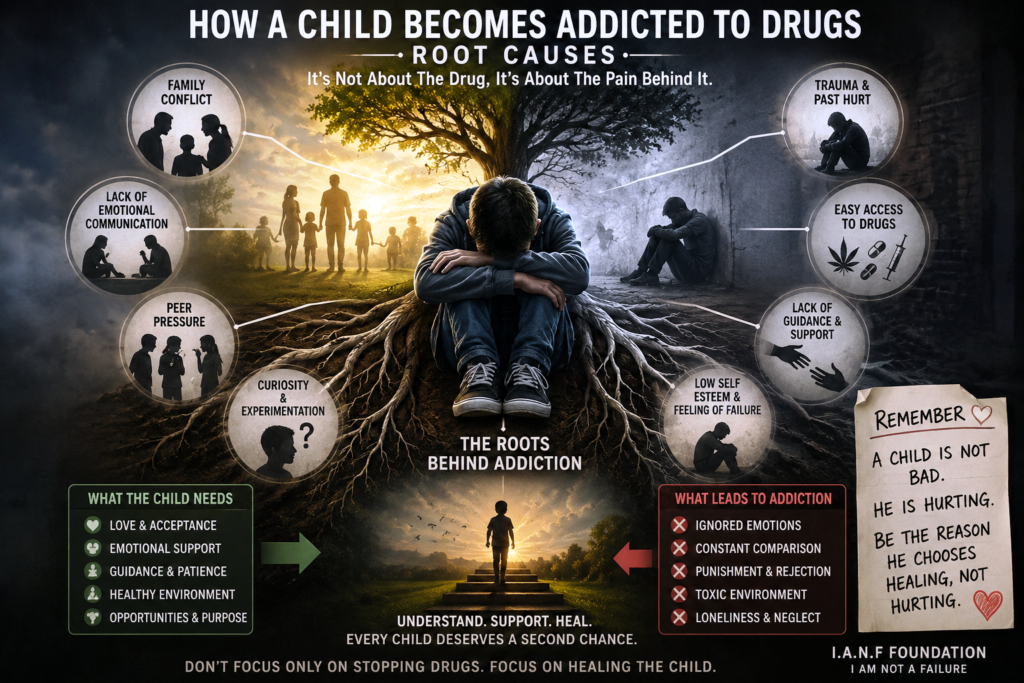
In my opinion, a child does not suddenly wake up one morning and decide to become a drug addict. Addiction is often a journey. It starts slowly—from curiosity, emotional pain, loneliness, family problems, peer pressure, or the need to feel accepted.
The drug may be visible, but the root cause is often hidden.
1. The Child Is Searching for an Escape
Sometimes a child is carrying emotional pain that nobody can see.
There may be:
- Family conflict
- Parental pressure
- Relationship problems
- Academic failure
- Bullying
- Loneliness
- Rejection
- Low self-esteem
- Feelings of failure
The child may not know how to express these emotions.
When he uses a drug for the first time, he may temporarily feel relaxed, confident, happy, or emotionally numb.
For a few hours, the problem feels far away.
Slowly, the brain learns a dangerous message:
“When I feel pain, drugs give me relief.”
This is where the emotional root of addiction may begin.
2. Lack of Emotional Communication in the Family
Many parents provide good food, clothes, education, and money to their children.
But sometimes one important thing is missing:
Emotional communication.
A child may live in the same house with the family but still feel emotionally alone.
Parents often ask:
“Did you eat?”
“How was your result?”
“Where are you going?”
But how often do we ask:
“Are you happy?”
“Is something hurting you?”
“Do you want to talk to me?”
When a child feels that nobody will understand him, he starts hiding his emotions.
Sometimes drugs become his silent companion.
3. Peer Pressure and the Need to Belong
Adolescence is a stage where acceptance becomes very important.
A child wants to be part of a group. He does not want friends to call him weak, boring, or immature.
A friend may say:
“Try it only once.”
“Nothing will happen.”
“Everyone does it.”
The first use may not be because the child loves drugs.
Sometimes the first use happens because the child is afraid of being rejected by the group.
In simple words, the child may choose a drug to avoid losing friends.
4. Curiosity Can Become a Trap
Children and teenagers are naturally curious.
They want to experience new things.
A child may think:
“Let me try it once.”
The problem is that the brain remembers pleasurable experiences.
Drugs can strongly affect the brain’s reward system and dopamine mechanism. The child may experience an artificial feeling of pleasure or relief.
The brain starts remembering:
Drug = Pleasure
Drug = Relief
Drug = Escape
Repeated use can slowly turn experimentation into a habit and, in some cases, dependence or addiction.
5. The Role of Dopamine
Dopamine is a chemical messenger involved in motivation, learning, and reward.
Normally, a child may feel pleasure after playing, achieving a goal, spending time with friends, or doing something enjoyable.
Some drugs produce unusually strong effects on the brain’s reward system.
With repeated drug use, normal activities may start feeling less interesting.
The child may say:
“I don’t enjoy anything.”
“I feel normal only after taking drugs.”
At this stage, we must understand that it is not always simply a matter of willpower.
The brain and behaviour may have started adapting to repeated drug use.
6. Family Environment Can Be a Root Factor
I do not believe in blaming every parent for a child’s addiction.
But we must honestly understand the child’s environment.
Constant fights at home, domestic conflict, excessive criticism, neglect, unrealistic expectations, or substance use within the family can affect a child’s emotional development.
Imagine a child who hears every day:
“You are useless.”
“You will never succeed.”
“Look at other children.”
Slowly, the child may start believing these words.
When a person feels like a failure, he may search for something that temporarily removes that feeling.
Sometimes that “something” is a drug.
Words spoken repeatedly in childhood can become the child’s inner voice.
7. Failure and Comparison
Today, children are constantly compared.
Marks.
Career.
Money.
Appearance.
Social media.
Relationships.
We teach children how to achieve success, but sometimes we forget to teach them how to handle failure.
What happens when a child fails?
Who teaches him to process rejection?
Who teaches him that one bad result does not define his entire life?
If a child believes, “I am a failure,” emotional pain can become deeper.
This is one reason I strongly believe that children need emotional guidance before they reach a crisis.
A failed situation does not mean a failed person.
8. Drugs Are Sometimes a Symptom, Not the Whole Problem
This is one of my strongest thoughts about addiction:
Sometimes the drug is not the original problem. The drug is a symptom of an untreated problem.
Behind addiction, we may find:
- Emotional pain
- Trauma
- Loneliness
- Anger
- Family conflict
- Rejection
- Lack of purpose
- Low self-worth
- Poor coping skills
If we only remove the drug but never understand the pain, the person may search for another escape.
That is why counselling is important in addiction treatment.
We must understand the person behind the addiction.
9. Punishment Is Not Always the Answer
When parents discover drug use, they may become angry.
They shout.
They threaten.
They insult.
Sometimes they use physical punishment.
The child then becomes more secretive.
Fear may stop communication, but it does not always stop addiction.
I believe the first step should be:
Listen. Understand. Assess. Then intervene.
This does not mean accepting drug use.
It means understanding the root before treating the problem.
My Thought
No child is born an addict.
Somewhere in the journey of life, the child may experience a situation, emotion, environment, or influence that opens the door to drug use.
Our responsibility as parents, teachers, counsellors, psychologists, and society is not only to say:
“Stop taking drugs.”
We must also ask:
“What are you trying to escape from?”
Because when we understand the root, we can work on real recovery.
Addiction treatment should not only focus on removing drugs from a person’s body.
We must help remove the pain, hopelessness, and emotional burden that may be pushing the person back towards drugs.
Don’t only see the addiction. See the person behind it.
Because a person who has failed at one stage of life is not a failure.
I Am Not a Failure — I.A.N.F Foundation
Understanding the person. Finding the root. Supporting a new beginning.
